http://www.native-languages.org/houses.htm
Wigwam Homes
Wigwams (or wetus) are Native American houses used by Algonquian Indians in the woodland regions. Wigwam is the word for "house" in the Abenaki tribe, and wetuis the word for "house" in the Wampanoag tribe. Sometimes they are also known as birchbark houses. Wigwams are small houses, usually 8-10 feet tall.
Wigwams are made of wooden frames which are covered with woven mats and sheets of birchbark. The frame can be shaped like a dome, like a cone, or like a rectangle with an arched roof. Once the birchbark is in place, ropes or strips of wood are wrapped around the wigwam to hold the bark in place. Here are some pictures of a woman building a wigwam.


cone-shaped dome-shaped rectangular shape wigwam frame
Wigwams are good houses for people who stay in the same place for months at a time. Most Algonquian Indians lived together in settled villages during the farming season, but during the winter, each family group would move to their own hunting camp. Wigwams are not portable, but they are small and easy to build. Woodland Indian families could build new wigwams every year when they set up their winter camps.
Longhouses
Longhouses are Native American homes used by the Iroquois tribes and some of their Algonquian neighbors. They are built similarly to wigwams, with pole frames and elm bark covering. The main difference is that longhouses are much, much larger than wigwams. Longhouses could be 200 feet long, 20 feet wide, and 20 feet high.
Inside the longhouse, raised platforms created a second story, which was used for sleeping space. Mats and wood screens divided the longhouse into separate rooms. Each longhouse housed an entire clan-- as many as 60 people!


Longhouses are good homes for people who intend to stay in the same place for a long time. A longhouse is large and takes a lot of time to build and decorate. The Iroquois were farming people who lived in permanent villages. Iroquois men sometimes built wigwams for themselves when they were going on hunting trips, but women might live in the same longhouse their whole life.
Tepees
Tepees (also spelled Teepees or Tipis) are tent-like American Indian houses used by Plains tribes. A tepee is made of a cone-shaped wooden frame with a covering of buffalo hide. Like modern tents, tepees are carefully designed to set up and break down quickly. As a tribe moved from place to place, each family would bring their tipi poles and hide tent along with them. Originally, tepees were about 12 feet high, but once the Plains Indian tribes acquired horses, they began building them twice as high.


Indian tepee photograph picture of tepees being set up
Tepees are good houses for people who are always on the move. Plains Indians migrated frequently to follow the movements of the buffalo herds. An entire Plains Indian village could have their tepees packed up and ready to move within an hour. There were fewer trees on the Great Plains than in the Woodlands, so it was important for Plains tribes to carry their long poles with them whenever they traveled instead of trying to find new ones each time they moved.
Indian tepee photograph picture of tepees being set up
Tepees are good houses for people who are always on the move. Plains Indians migrated frequently to follow the movements of the buffalo herds. An entire Plains Indian village could have their tepees packed up and ready to move within an hour. There were fewer trees on the Great Plains than in the Woodlands, so it was important for Plains tribes to carry their long poles with them whenever they traveled instead of trying to find new ones each time they moved.
Grass Houses
Grass houses are American Indian homes used in the Southern Plains by tribes such as the Caddos. They resemble large wigwams but are made with different materials. Grass houses are made with a wooden frame bent into a beehive shape and thatched with long prairie grass. These were large buildings, sometimes more than 40 feet tall.


Wichita grass house Caddo grass house construction
Grass houses are good homes for people in a warm climate. In the northern plains, winters are too cold to make homes out of prairie grass. But in the southern plains of Texas, houses like these were comfortable for the people who used them.
Wichita grass house Caddo grass house construction
Grass houses are good homes for people in a warm climate. In the northern plains, winters are too cold to make homes out of prairie grass. But in the southern plains of Texas, houses like these were comfortable for the people who used them.
Wattle and Daub Houses
Wattle and daub houses (also known as asi, the Cherokee word for them) are Native American houses used by southeastern tribes. Wattle and daub houses are made by weaving rivercane, wood, and vines into a frame, then coating the frame with plaster. The roof was either thatched with grass or shingled with bark.


rivercane frame plastered and thatched
Wattle and daub houses are permanent structures that take a lot of effort to build. Like longhouses, they are good homes for agricultural people who intended to stay in one place, like the Cherokees and Creeks. Making wattle and daub houses requires a fairly warm climate to dry the plaster.
rivercane frame
plastered and thatched Wattle and daub houses are permanent structures that take a lot of effort to build. Like longhouses, they are good homes for agricultural people who intended to stay in one place, like the Cherokees and Creeks. Making wattle and daub houses requires a fairly warm climate to dry the plaster.
Chickees
Chickees (also known as chickee huts, stilt houses or platform dwellings) are Native American homes used primarily in Florida by tribes like the Seminole Indians. Chickee houses consisted of thick posts supporting a thatched roof and a flat wooden platform raised several feet off the ground. They did not have any walls. During rainstorms, Florida Indians would lash tarps made of hide or cloth to the chickee frame to keep themselves dry, but most of the time, the sides of the structure were left open.


drawing of a chickee Seminole chickee
Chickees are good homes for people living in a hot, swampy climate. The long posts keep the house from sinking into marshy earth, and raising the floor of the hut off the ground keeps swamp animals like snakes out of the house. Walls or permanent house coverings are not necessary in a tropical climate where it never gets cold.
drawing of a chickee Seminole chickee
Chickees are good homes for people living in a hot, swampy climate. The long posts keep the house from sinking into marshy earth, and raising the floor of the hut off the ground keeps swamp animals like snakes out of the house. Walls or permanent house coverings are not necessary in a tropical climate where it never gets cold.
Adobe Houses
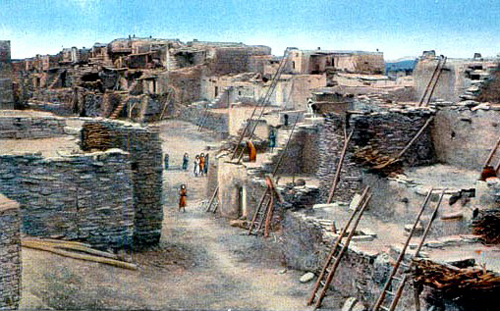
Adobe houses (also known as pueblos) are Native American house complexes used by the Pueblo Indians of the Southwest. Adobe pueblos are modular, multi-story houses made of adobe (clay and straw baked into hard bricks) or of large stones cemented together with adobe. Each adobe unit is home to one family, like a modern apartment. The whole structure, which can contain dozens of units, is often home to an entire extended clan.


Hopi Mesa pueblos
Adobe houses are good homes to build in a warm, dry climate where adobe can be easily mixed and dried. These are homes for farming people who have no need to move their village to a new location. In fact, some Pueblo people have been living in the same adobe house complex, such as Sky City, for dozens of generations.
Adobe houses are good homes to build in a warm, dry climate where adobe can be easily mixed and dried. These are homes for farming people who have no need to move their village to a new location. In fact, some Pueblo people have been living in the same adobe house complex, such as Sky City, for dozens of generations.
Earthen Houses
Earthen house is a general term referring to several types of Native American homes including Navajo hogans, Sioux earth lodges, subarctic sod houses, and Native American pit houses of the West Coast and Plateau. Earthen houses made by different tribes had different designs, but all were semi-subterranean dwellings -- basement-like living spaces dug from the earth, with a domed mound built over the top (usually a wooden frame covered with earth or reeds.)


Pawnee earth lodge Navajo hogan Alaskan sod house
Earthern houses are good for people who want permanent homes and live in an area that is not forested. (It's difficult work to excavate underground homes in areas with many tree roots!) Living partially underground has several benefits, especially in harsh climates-- the earth offers natural protection from wind and strong weather.
Pawnee earth lodge Navajo hogan Alaskan sod house
Earthern houses are good for people who want permanent homes and live in an area that is not forested. (It's difficult work to excavate underground homes in areas with many tree roots!) Living partially underground has several benefits, especially in harsh climates-- the earth offers natural protection from wind and strong weather.
Plank Houses
Plankhouses are Native American homes used by tribes of the Northwest Coast (from northern California all the way up to Alaska.) Plank houses are made of long, flat planks of cedar wood lashed to a wooden frame. Native American plank houses look rather similar to old European houses, but the Indians didn't learn to build them from Europeans-- this style of house was used on the Northwest Coast long before Europeans arrived.


Chinook plankhouse Yurok plank house
Plank houses are good houses for people in cold climates with lots of tall trees. However, only people who don't need to migrate spend the time and effort to build these large permanent homes. Most Native Americans who live in the far northern forests must migrate regularly to follow caribou herds and other game, so plank houses aren't a good choice for them. Only coastal tribes, who make their living by fishing, made houses like these.
Plank houses are good houses for people in cold climates with lots of tall trees. However, only people who don't need to migrate spend the time and effort to build these large permanent homes. Most Native Americans who live in the far northern forests must migrate regularly to follow caribou herds and other game, so plank houses aren't a good choice for them. Only coastal tribes, who make their living by fishing, made houses like these.
Igloos
Igloos (or Iglu) are snow houses used by the Inuit (Eskimos) of northern Canada. Not all Inuit people used igloos -- some built sod houses instead, using whale bones instead of wooden poles for a frame. Like a sod house, the igloo is dome-shaped and slightly excavated, but it is built from the snow, with large blocks of ice set in a spiral pattern and packed with snow to form the dome.


Inuit (Eskimo) igloo Building an igloo Inside an igloo
Igloos are good houses for the polar region, where the earth is frozen, the snow cover is deep, and there are few trees. Snow is a good insulator, and dense blocks of ice offer good protection against the arctic winds.
Inuit (Eskimo) igloo Building an igloo Inside an igloo
Igloos are good houses for the polar region, where the earth is frozen, the snow cover is deep, and there are few trees. Snow is a good insulator, and dense blocks of ice offer good protection against the arctic winds.
Brush Shelters
Brush shelters (including wickiups, lean-tos, gowa, etc.) are temporary Native American dwellings used by many tribes. Brush shelters are typically very small, like a camping tent. People cannot usually stand up straight inside brush lodges -- they are only used for sleeping in. A brush shelter is made of a simple wooden frame covered with brush (branches, leaves, and grass.) The frame can be cone-shaped, with one side left open as a door, or tent-shaped, with both ends left open.


conical frame conical wickiup tent-shaped frame tent-shaped brush lodge
Most Native Americans only made a brush shelter when they were out camping in the wilderness. But some migratory tribes who lived in warm dry climates, such as the Apache tribes, built brush shelters as homes on a regular basis. They can be assembled quickly from materials that are easy to find in the environment, so people who build villages of brush shelters can move around freely without having to drag teepee poles.
Most Native Americans only made a brush shelter when they were out camping in the wilderness. But some migratory tribes who lived in warm dry climates, such as the Apache tribes, built brush shelters as homes on a regular basis. They can be assembled quickly from materials that are easy to find in the environment, so people who build villages of brush shelters can move around freely without having to drag teepee poles.