Cherokee Morning Song

Wednesday, December 3, 2014

The Shocking Rates Of Violence And Abuse Facing Native American Kids

POSTED ON 

http://thinkprogress.org/health/2014/11/18/3593300/violence-native-american-kids/

Darrell Follette and Ida Follette recount the day their daughter committed suicide on the Fort Peck Indian Reservation

CREDIT: AP PHOTO/MICHAEL ALBANS
A panel of experts has released a lengthy report detailing the extent of the public  health issues plaguing American Indian children who live on tribal land, concluding that these kids’ lives are being “destroyed by relentless violence and trauma.”
According to the researchers, American Indian kids suffer from disproportionately high rates of abuse and neglect, and most of them aren’t receiving any treatment for those issues. They experience post-traumatic stress disorder at roughly the same rate as service members returning from the Iraq and Afghanistan Wars. And they’re twice as likely as any other race to die before the age of 24.
“Today, a vast majority of American Indian and Alaska Native children live in communities with alarmingly high rates of poverty, homelessness, drug abuse, alcoholism, suicide, and victimization,” the report states. “Domestic violence, sexual assault, and child abuse are widespread. Continual exposure to violence has a devastating impact on child development and can have a lasting impact on basic cognitive, emotional, and neurological functions.”
To remedy these issues, the group is pressuring Attorney General Eric Holder to extend more legal protections to children on Native American reservations, including allowing the government to criminally prosecute non-Indian people who commit violence against kids in tribes.
There are 566 federally-recognized Native American tribes across the country. Under a 1978 Supreme Court ruling, however, those tribes are prohibited from exercising criminal jurisdiction over outside defendants — something that’s historically hampered their ability to crack down on sexual violence.
Lats year, with the passage of an expanded version of the Violence Against Women Act (VAWA), Native American women gained these type of protections from domestic violence and abuse. The Justice Department has been rolling out a pilot program to integrate this new legal standard on some tribal land. Now, if women on those reservations report an assault perpetrated by a non-Indian, the tribe’s police chief will have more recourse to go after that perpetrator.
But VAWA only applies to women — and doesn’t extend the same type of protection to American Indian children who are victims of abuse or assault. That’s a loophole that the expert task force, which was assembled by the Attorney General’s office specifically to provide a better snapshot of the issues with violence on reservations, wants to close. In communities where the rates of sexual abuse are high and the youth suicide rate has been climbing, experts want to find a better way to support young people.
The new report puts forth several recommendations for strengthening the safety net for Native American kids, including increasing the Department of Justice’s funding for tribal justice programs and establishing a federal Native American Affairs Office that employs an official dedicated to overseeing issues related to minors living on reservations.
Some of the proposed policy changes in the report can be accomplished through executive actions, while others require new state and federal legislation. But it’s possible there will be some political resistance. During the recent fight over VAWA, the added protections for Native American woman were a sticking point for Congressional Republicans, who didn’t want to extend tribal authority. Before VAWA was eventually re-authorized, Republicans refused to pass the expanded version and allowed the law to lapse in the first time since its 1994 passage.
Despite the potential political controversy, the authors of the report state their objectives in terms of basic civil rights and justice, noting that “lives are at stake.”
“This is a defining moment for our nation and for this generation,” the report concludes. “How we choose to deal with the current public safety crisis in Native America — a crisis largely of the Federal government’s own making over more than a century of failed laws and policies — can set our generation apart from the legacy that remains one of great unfinished challenges of the Civil Rights Movement.”

Monday, December 1, 2014

Cancer cured by 'medicine man', First Nations man says


An Anishnawbe man from northwestern Ontario says traditional healing practices "got rid" of his leukemia, and he's concerned recent controversy over the treatment of two First Nations girls in southern Ontario will rob others of a cure.
On Nov. 14, an Ontario judge dismissed an application from McMaster Children's Hospital in Hamilton that would have forced chemotherapy on an 11-year-old First Nations girl. Earlier this year there were concerns that children's aid would intervene in the case of another First Nations girl after her family withdrew her from chemotherapy.
"People who [were] trying to take the child away, they're just close minded about the possibilities of traditional healing," said Daryl Archie. "I'm alive and well and a good example that it does work."
'All those needles'
The 47-year-old from Big Grassy River First Nation, was diagnosed with leukemia when he was a 19-year-old and sent to Winnipeg for chemotherapy. He said doctors gave him a 50/50 chance of survival.
"Some of those medical treatments they do are pretty painful. They stick a big needle into your hip bone for marrow with no pain killers at all," Archie said, recalling that the chemotherapy drugs made him feel "antsy and anxious."
"Eventually I got tired of the drugs and all those needles."
After about 6 months of unsuccessful treatments Archie left Winnipeg. "I guess I felt like I'd just go home and, I don't know," he said, his voice trailing off. He was close to death. "I wondered why is this happening to me?"
Archie went to Roseau River First Nation in Manitoba and took part in traditional Anishnawbe ceremonies.Archie went to Roseau River First Nation in Manitoba and took part in traditional Anishnawbe ceremonies.
Sweat lodge and shaking tent
But then Archie's sister found "a traditional healer, a medicine man, who I could go see who would help me," he said.
He travelled to Roseau River First Nation in Manitoba and took part in traditional Anishnawbe ceremonies like the sweat lodge and shaking tent and was introduced to a healer named Eddie Two-Teeth from Montana. Two-Teeth conducted more ceremonies and Archie travelled with him to the United States.
"He gave me some medicine, it was a small tree and he told me to wrap it in a circle (it was about six to eight inches across) and to boil that and drink the water from there and to drink it for 30 days," Archie said.
The healer told him to keep a positive attitude and when the 30 days were up to go to a doctor for a blood test.
 "So I did and my doctor, after the test came back, he told me my blood was just as good as his," Archie said. "So that told me I was rid of the leukemia."
'With the help of the Creator'
Archie said he has remained healthy in the decades since he was cured. He's not sure why the traditional ways worked for him when chemotherapy failed, but believes it's related to prayer.
"With traditional medicine, it's with the help of the Creator and with western medicine it's all just all chemicals and drugs that they put into your body," he said. "With the ceremonies, the Creator is right there. They don't even talk about that in the hospital."
The families of both of the First Nations girls choose to remove them from chemotherapy. They have sought alternative treatment at a clinic in Florida that they say is in line with traditional indigenous medicine. Questions have been raised about the clinic and the qualifications of the man who is treating them.
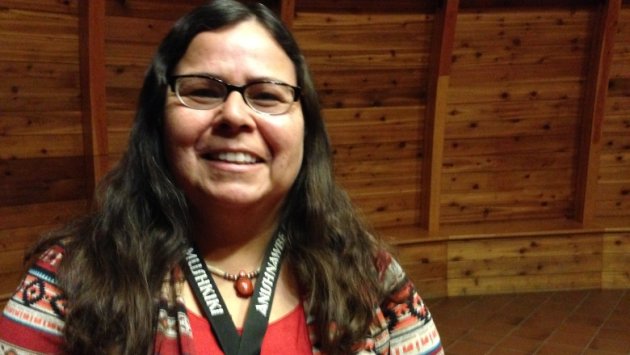
​Teresa Trudeau is the traditional healing coordinator at Anishnawbe Mushkiki in Thunder Bay.​Teresa Trudeau is the traditional healing coordinator at Anishnawbe Mushkiki in Thunder Bay.
'Credibility comes from the community'
Archie isn't familiar with the details of the girls' treatment, but he said he felt confident about Eddie Two-Teeth's skills as a healer "from talking to the people in Roseau River and what they've seen and people that had gotten healed already from this medicine man," he said. "That kind of reinforced my belief in him."
​Teresa Trudeau said that's the way verification of healers generally works. Trudeau is the traditional healing coordinator at Anishnawbe Mushkiki in Thunder Bay, one of several Native Health Access Centres across Ontario that provide both western medicine and First Nations healing.
"Credibility comes from the community when it comes to traditional health care," Trudeau said. "That's how someone becomes recognized. The references are very important."
Traditional and western medicine can work together
Trudeau said the most common misconception she encounters is that patients must choose between seeing a doctor or seeing a healer.
"It's not an either/or, you can work hand in hand with traditional and western medicine, in fact it's necessary," she said, adding that healers often rely on diagnostics such as blood tests or x-rays to better treat their patients.
Trudeau said there are some standard plant-based medicines that are used by healers to treat a variety of ailments, but "medicine people" will also use ceremony to receive a vision of a particular medicine to use for an individual seeking their help.
"A ceremony to seek that medicine is necessary," she said. "With spiritual guidance, through prayer, the traditional healer will see that medicine visually, it will come to them, the particular medicine that individual will need. It's not to say that one medicine will work for everybody."
True "medicine people" are rare, Trudeau said, perhaps one or two per province in Canada. But she adds traditional healing is accessible to everyone.
"We are healers within all of us. That's what our healers do. They show us how to heal ourselves on our own. That's part of empowerment, is teaching people how to do that," she said.
"It's not the healer who heals us. You heal yourself."

Thursday, November 27, 2014

8 Things The History Books Don’t Tell Us About Native People

http://nativewarriors.net/8-things-the-history-books-dont-tell-us-about-native-people.html

EF

Originally published on Indian Country Today Media Network

Do history books written by white folks tell the truth about Natives in the US? We think not.

Here are just some of the things they fail to mention.

1. Columbus NEVER landed in the Upper 48—Ever

Every year across the country countless elementary school students recite: “In 1492, Columbus sailed the ocean blue,” and many perform a play about him discovering Indians in America.

The thing is, Columbus never landed in what would become the United States. He actually landed in the Caribbean.

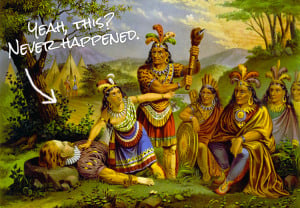
2. Basically Everything About Pocahontas

Pocahontas was about 8 years old when John Smith arrived, and was later married to another young Indian warrior. She also had a child that was given away before she was kidnapped by the English and then married to John Rolfe.

Sorry Disney, and many incorrectly written textbooks, Pocahontas never fell in love with John Smith.

According to tribal oral histories as well as The True Story of Pocahontas by members of the Mattaponi Tribe, Pocahontas’ original young Native husband was killed and Pocahontas’ newborn was given to relatives before she was forced into captivity at about 15 or 16 years of age.

3. The First Thanksgiving

Thanksgiving was named after an entire tribe’s massacre — not a peaceful meal between pilgrims and Indians.

In 1621, Wampanoag Indians investigated gun and cannon fire at a Pilgrim settlement to see them celebrating a successful harvest. The Indians — all male warriors, were fed as a gesture of peace. The act was not repeated annually.

In 1636, when a murdered man was discovered in a boat in Plymouth, English Major John Mason collected his soldiers and killed and burned down the wigwams of all the neighboring Pequot Indians who were blamed for the murder.

The following day, Plymouth Governor William Bradford applauded the massacre of the 400 Indians, including the women and children. The Governor of the Massachusetts Bay Colony, William Newell, proclaimed: “From that day forth, shall be a day of celebration and thanks giving for subduing the Pequots.”

For the next 100 years, every Thanksgiving Day ordained by a governor was in honor of the bloody victory, thanking God that the battle had been won.

4. What is a Redskin?

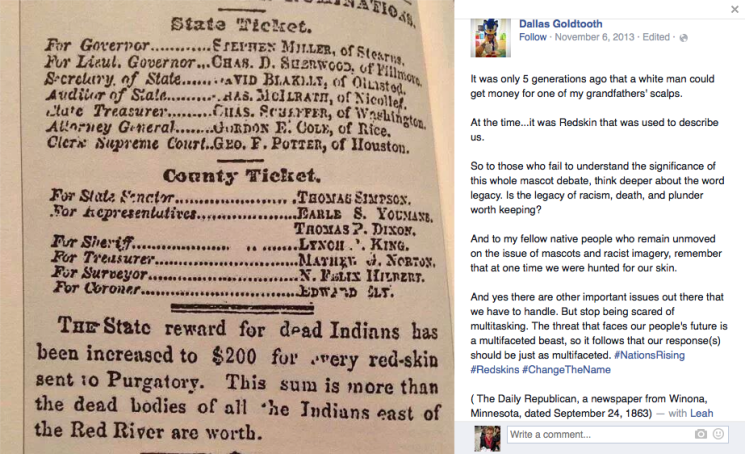
“It was only five generations ago that a white man could get money for one of my grandfather’s scalps,” wrote 1491’s comedian Dallas Goldtooth on Facebook. “At this time… it was ‘Redskin’ that was used to describe us.”

In his post, Goldtooth also included a newspaper clipping from after the U.S. Dakota Wars of 1862: “The state reward for dead Indians has been increased to $200 for every red-skin sent to Purgatory.”

 A screen shot of Goldtooth’s Facebook page with the 1863 newspaper clipping and his comments that sparked discussion on Facebook.

5. Lincoln Ordered a Mass Execution

In the fall of 1862, Native tribes in Minnesota waged war on white settlers out of frustration from starvation, mistreatment and harsh conditions.
After soldiers captured over 300 Indians, President Abraham Lincoln approved the largest mass execution in U.S. history on 38 Dakota men.
On the day of their hanging, an estimated 4,000 spectators watched them hung. Their bodies were later taken and used as medical cadavers.

6. Hitler Studied Reservations

There are many accounts of the Nazis and Hitler studying Indian reservations for guidance in planning encampments for the Jewish. Perhaps Lia Mandelbaum says it best in her article found in the Jewish Journal entitled “Hitler’s Inspiration and Guide: The Native American Holocaust.”

From 1863 to 1868, the U.S. military persecuted and imprisoned 9,500 Navajo (the Diné) and 500 Mescalero Apache (the N’de). Living under armed guards, in holes in the ground, with extremely scarce rations, it is no wonder that more than 3,500 Navajo and Mescalero Apache men, women, and children died while in the concentration camp.

During the film I learned about something that shook me to my core that I had not heard before. I learned that the genocidal mentality and actions of the U.S. policy makers would find similar expression years later when the Nazis, under Hitler, studied the plans of Bosque Redondo to design the concentration camps for Jews.

7. There Are 566 Federally Recognized Tribes in the U.S.

When I was a student in high school, I learned that George Washington saw Indians in Virginia and possibly heard once or twice about the Cherokee Trail of Tears.
But in 18 years of public school (and a few of private Catholic School) — not once did I learn about the multitude of tribes, languages or cultures involved in this country.
NOT ONCE.

8. Unwritten History of African Americans and Natives

Dr. Arica L. Coleman is the assistant professor of Black American Studies at the University of Delaware. She is African American and Native American (Rappahannock).

Due to her ancestry, she has done a lot of thinking about the relations and interactions of Blacks, Indians and whites on the East Coast, primarily in Virginia.
According to Coleman, who turned her Ph.D. dissertation into a book titled That the Blood Stay Pure, there was Indian slavery in Virginia.

“The first slaves in the Americas were Native American and this business that the Native Americans died off as a result of disease and war [is inaccurate]—those were not the only reasons for their demise, there was the Indian slave trade, which is something we do not discuss a lot,” she writes.

Coleman also writes about Walter Plecker, a man who once worked as the first registrar of Virginia’s Bureau of Vital Records. A man who literally changed races in Virginia’s birth records. His actions have been coined as “pencil genocide.”

Similarly, William Loren Katz, the author of Black Indians has written how entire cities of blacks and Indians came together as a strong force against European settlers including huge factions of black Seminoles who created nearly impenetrable forces against those soldiers foolish enough to try and break into Florida, and suffered miserable defeats over several years.

Student Suspended for Speaking Native American Language


http://indiancountrytodaymedianetwork.com/2012/02/07/student-suspended-speaking-native-american-language-96340

Miranda Washinawatok, 12, is a student at Sacred Heart Catholic Academy.

2/7/12

After a 12-year-old Menominee student spoke her Native language during class, she was suspended from playing in that night’s basketball game, and memories of past boarding school atrocities surfaced.
Miranda Washinawatok attends Sacred Heart Catholic Academy in Shawano, Wisconsin. According toNative News Network, the school is more than 60 percent Native American and is about six miles from the Menominee Indian Tribe Reservation.
When Miranda was teaching a classmate to say “posoh” and “ketapanen” on January 19, her teacher scolded her. Native News Network reported her saying “You are not to speak like that! How do I know you’re not saying something bad? How would you like it if I spoke in Polish and you didn’t understand?”
The words Miranda was chastised for translate to “hello” and “I love you” in Menominee.
“Miranda kept saying she was only told by her assistant coach she was being benched because two teachers said she had a bad attitude,” Tanaes Washinawatok, Miranda’s mother, told Native News Network. “I wanted to know what she did to make them say she had a bad attitude.”
There is dispute over who actually did the suspending, but the school has admitted it “failed miserably in its handling of the matter.” Deacon Ray DuBois, the communication director for the Diocese of Green Bay, which operates the school, also told Native News Network that the school does not prohibit the use of any language and that “the number one priority is to help this girl.”
Miranda isn’t a troublemaker. Her mother told Native News that she is mature and respectful. Miranda plays basketball and is the team captain of a volleyball team.
“When it comes to Native language, Miranda should be proud she learned and can speak her Native language,” wrote Levi Rickert in a February 4 post on Native News Network.
Tara McGregor, a commenter at Nativenewsnetwork.com, says “As a teacher you have a responsibility to be culturally aware of your students and encourage diversity. This is a reminder to all of us that this type of oppression still exists. I hope that this example of ignorance is not forgotten, and we continue to move forward while creating a world that fosters children who embrace their heritage.”
Rhonda LeValdo, of the Acoma Pueblo and president of the Native American Journalists Association, wrote a piece forNative Connection stating Indian country's support for Miranda. She says: "All  Americans need to know about the boarding schools. They need to know how the language was beaten out of many of our elders, so much that their children never learned the language for that fear of them being hurt. This all happened in this country and so many deny the abuses, but it happened."

Read more athttp://indiancountrytodaymedianetwork.com/2012/02/07/student-suspended-speaking-native-american-language-96340

Wednesday, November 26, 2014

What Really Happened at the First Thanksgiving? The Wampanoag Side of the Tale

11/23/12

Read more at http://indiancountrytodaymedianetwork.com/2012/11/23/what-really-happened-first-thanksgiving-wampanoag-side-tale-and-whats-done-today-145807


When you hear about the Pilgrims and “the Indians” harmoniously sharing the “first Thanksgiving” meal in 1621, the Indians referred to so generically are the ancestors of the contemporary members of the Wampanoag Nation. As the story commonly goes, the Pilgrims who sailed from England on the Mayflower and landed at what became Plymouth, Massachusetts, in 1620 had a good harvest the next year. So Plymouth Gov. William Bradford organized a feast to celebrate the harvest and invited a group of “Native American allies, including the Wampanoag chief Massasoit” to the party. The feast lasted three days and, according to chronicler Edward Winslow, Bradford sent four men on a “fowling mission” to prepare for the feast and the Wampanoag guests brought five deer to the party. And ever since then, the story goes, Americans have celebrated Thanksgiving on the fourth Thursday of November. Not exactly, Ramona Peters, the Mashpee Wampanoag Tribe’s Tribal Historic Preservation Officer told Indian Country Today Media Network in a conversation on the day before Thanksgiving 2012—391 years since that mythological “first Thanksgiving.”
We know what we’re taught in mainstream media and in schools is made up. What’s the Wampanoag version of what happened?
Yeah, it was made up. It was Abraham Lincoln who used the theme of Pilgrims and Indians eating happily together. He was trying to calm things down during the Civil War when people were divided. It was like a nice unity story.
So it was a political thing?
Yes, it was public relations. It’s kind of genius, in a way, to get people to sit down and eat dinner together. Families were divided during the Civil War.
So what really happened?
We made a treaty. The leader of our nation at the time—Yellow Feather Oasmeequin [Massasoit] made a treaty with (John) Carver [the first governor of the colony]. They elected an official while they were still on the boat. They had their charter. They were still under the jurisdiction of the king [of England]—at least that’s what they told us. So they couldn’t make a treaty for a boatload of people so they made a treaty between two nations—England and the Wampanoag Nation.
What did the treaty say?
It basically said we’d let them be there and we would protect them against any enemies and they would protect us from any of ours. [The 2011 Native American copy coin commemorates the 1621 treaty between the Wampanoag tribe and the Pilgrims of Plymouth colony.] It was basically an I’ll watch your back, you watch mine’ agreement. Later on we collaborated on jurisdictions and creating a system so that we could live together.
What’s the Mashpee version of the 1621 meal?
You’ve probably heard the story of how Squanto assisted in their planting of corn? So this was their first successful harvest and they were celebrating that harvest and planning a day of their own thanksgiving. And it’s kind of like what some of the Arab nations do when they celebrate by shooting guns in the air. So this is what was going on over there at Plymouth. They were shooting guns and canons as a celebration, which alerted us because we didn’t know who they were shooting at. So Massasoit gathered up some 90 warriors and showed up at Plymouth prepared to engage, if that was what was happening, if they were taking any of our people. They didn’t know. It was a fact-finding mission.
When they arrived it was explained through a translator that they were celebrating the harvest, so we decided to stay and make sure that was true, because we’d seen in the other landings—[Captain John] Smith, even the Vikings had been here—so we wanted to make sure so we decided to camp nearby for a few days. During those few days, the men went out to hunt and gather food—deer, ducks, geese, and fish. There are 90 men here and at the time I think there are only 23 survivors of that boat, the Mayflower, so you can imagine the fear. You have armed Natives who are camping nearby. They [the colonists] were always vulnerable to the new land, new creatures, even the trees—there were no such trees in England at that time. People forget they had just landed here and this coastline looked very different from what it looks like now. And their culture—new foods, they were afraid to eat a lot of things. So they were very vulnerable and we did protect them, not just support them, we protected them. You can see throughout their journals that they were always nervous and, unfortunately, when they were nervous they were very aggressive.
So the Pilgrims didn’t invite the Wampanoags to sit down and eat turkey and drink some beer?
[laughs] Ah, no. Well, let’s put it this way. People did eat together [but not in what is portrayed as “the first Thanksgiving]. It was our homeland and our territory and we walked all through their villages all the time. The differences in how they behaved, how they ate, how they prepared things was a lot for both cultures to work with each other. But in those days, it was sort of like today when you go out on a boat in the open sea and you see another boat and everyone is waving and very friendly—it’s because they’re vulnerable and need to rely on each other if something happens. In those days, the English really needed to rely on us and, yes, they were polite as best they could be, but they regarded us as savages nonetheless.
So you did eat together sometimes, but not at the legendary Thanksgiving meal.
No. We were there for days. And this is another thing: We give thanks more than once a year in formal ceremony for different season, for the green corn thanksgiving, for the arrival of certain fish species, whales, the first snow, our new year in May—there are so many ceremonies and I think most cultures have similar traditions. It’s not a foreign concept and I think human beings who recognize greater spirit then they would have to say thank you in some formal way.
What are Mashpee Wampanoags taught about Thanksgiving now?
Most of us are taught about the friendly Indians and the friendly Pilgrims and people sitting down and eating together. They really don’t go into any depth about that time period and what was going on in 1620. It was a whole different mindset. There was always focus on food because people had to work hard to go out and forage for food, not the way it is now. I can remember being in Oklahoma amongst a lot of different tribal people when I was in junior college and Thanksgiving was coming around and I couldn’t come home—it was too far and too expensive—and people were talking about, Thanksgiving, and, yeah, the Indians! And I said, yeah, we’re the Wampanoags. They didn’t know! We’re not even taught what kind of Indians, Hopefully, in the future, at least for Americans, we do need to get a lot brighter about other people.
So, basically, today the Wampanoag celebrate Thanksgiving the way Americans celebrate it, or celebrate it as Americans?
Yes, but there’s another element to this that needs to be noted as well. The Puritans believed in Jehovah and they were listening for Jehovah’s directions on a daily basis and trying to figure out what would please their God. So for Americans, for the most part there’s a Christian element to Thanksgiving so formal prayer and some families will go around the table and ask what are you thankful for this year. In Mashpee families we make offerings of tobacco. For traditionalists, we give thanks to our first mother, our human mother, and to Mother Earth. Then, because there’s no real time to it you embrace your thanks in passing them into the tobacco without necessarily speaking out loud, but to actually give your mind and spirit together thankful for so many things… Unfortunately, because we’re trapped in this cash economy and this 9-to-5 [schedule], we can’t spend the normal amount of time on ceremonies, which would last four days for a proper Thanksgiving.
Do you regard Thanksgiving as a positive thing?
As a concept, a heartfelt Thanksgiving is very important to me as a person. It’s important that we give thanks. For me, it’s a state of being. You want to live in a state of thanksgiving, meaning that you use the creativity that the Creator gave you. You use your talents. You find out what those are and you cultivate them and that gives thanks in action.
And will your family do something for Thanksgiving?
Yes, we’ll do the rounds, make sure we contact family members, eat with friends and then we’ll all celebrate on Saturday at the social and dance together with the drum.

Read more athttp://indiancountrytodaymedianetwork.com/2012/11/23/what-really-happened-first-thanksgiving-wampanoag-side-tale-and-whats-done-today-145807

Monday, November 24, 2014

Stealing Children: A Look at Indigenous Child Removal Policies

http://indiancountrytodaymedianetwork.com/2014/11/21/stealing-children-look-indigenous-child-removal-policies-157884

Margaret Jacobs A Generation Removed
Craig Chandler/University Communications/University of Nebraska-Lincoln
Margaret Jacobs, professor of history and director of the Women’s and Gender Studies Program at the University of Nebraska, Lincoln, has just published a second volume based on her research.

Read more athttp://indiancountrytodaymedianetwork.com/2014/11/21/stealing-children-look-indigenous-child-removal-policies-157884

Tanya H. Lee

Margaret Jacobs, professor of history and director of the Women’s and Gender Studies Program at the University of Nebraska, Lincoln, won the Bancroft Prize for her bookWhite Mother to a Dark Race, an investigation of the U.S. and Australian policies of breaking up indigenous families and removing children to be raised in boarding schools run by whites. She has just published a second volume based on her research.A Generation Removedlooks at indigenous child removal policies from just after World War II up until passage of the Indian Child Welfare Act in 1978.
ICTMN interviewed Jacobs about her work. “When I got to Australia [to begin research] it was shortly after the ‘Bringing them home’ report [1997] had come out about the stolen generation [of Australian Aborigine children]. When I went to the archives, I asked, ‘What were white women doing about indigenous children? Were they involved in this policy of the stolen generation?’”
She very quickly discovered that they were. “I was surprised that they were involved because this was an era when white women worldwide were talking about themselves as wanting to extend their maternal instincts and impulses into the world at large. So I assumed these women would be supporting indigenous motherhood and supporting the rights of indigenous women to keep their children.”
But instead, white women “really thought that indigenous women didn’t mother properly. They worked to some extent on trying to teach indigenous women how they thought they should be taking care of their children and carrying out their domestic duties. But many of them believed when there was resistance that the only way to raise children properly was to take them away from the environment of their mothers and cultures.”
Coming back to the U.S., she asked the same question and found that “many white women were involved in even a more pronounced manner in the United States than in Australia. They were involved in creating policy and were even hired by the federal government to carry out the policy of removing indigenous children.”
“So that was the book that I wrote. It was calledWhite Mother to a Dark Race: Settler Colonialism, Maternalism, and the Removal of Indigenous Children in the American West and Australia, 1880-1940. As I was researching that book I was also very interested in looking at more recent examples of the removal of indigenous children. This second book, calledA Generation Removed: The Fostering and Adoption of Indigenous Children in the Postwar World, focuses less on white women and much more on indigenous women’s experience of having children removed and the activism that they engaged in to reclaim the care of their children.”
Jacobs found that during the termination period, the Bureau of Indian Affairs was eager to close down the boarding schools because they were not accomplishing the goal of assimilating American Indian children into the mainstream culture, and they were expensive.
“So they turned to this policy of trying to close down the boarding schools and they turned toward a policy of trying to turn over the education and care of Indian children to the states,” says Jacobs.
While there were some American Indians working for the BIA in the ‘50s and some sympathy to the problems of Indian families, says Jacobs, “there were rarely any American Indian people working in the state bureaucracies. And there were rarely any people trained to have any sensitivity to American Indian societies or concerns. So this move to change the jurisdiction over Indian children to the states was a move that contributed to greater numbers of Indian children being removed from their families, fostered by white families and eventually moved into the adoption system.”
Jacobs says a close examination of the records shows that 25 percent to 35 percent of Indian children were removed from their families.
In the course of her research, she says, “I was able to find all of these women in their own tribal communities who were working to create really innovative programs to promote child welfare within their communities. They were trying to find foster families within the community. They were creating these kinds of preventative programs for families to prevent children from being taken in the first place and to strengthen families or rehabilitate families. These women were quite incredible. Some were also getting involved in a national level to try to organize to stop this practice.”
One of these women was Evelyn Blanchard, Laguna/Yaqui, who became an advocate for children and families after losing a court case in which Navajo grandparents were not allowed to take custody of their grandchild, who had been placed outside the community. She worked with the Association on American Indian Affairs to help get the Indian Child Welfare Act passed in 1978. “After the law was passed,” Blanchard told ICTMN, “I worked with many tribes to help them develop their own children’s codes regarding care of children in their communities and to help them figure out how they would respond to the law, which was written for state courts, not Indian tribes.”
Evelyn Blanchard began her advocacy on behalf of American Indian children and families in the 1970s. (Photo courtesy of the University of Nebraska Press)
Blanchard explains, “The ICWA regulates the acts of state courts or public and private agencies. That’s what it’s supposed to do and its intent is to prevent the breakup of the Indian families because records show that before the passage one out of every four children had been removed from his or her family and 85 percent of those kids were not in Indian homes. The tribes were tired of it. They wanted it stopped and the pattern reversed.”
Asked whether the Baby Veronica case was an anomaly in present-day Indian child welfare proceedings, Blanchard responds, “It’s not an anomaly. Those situations occur regularly. And in the majority of cases, I would venture the people yet do not have the legal assistance and counsel they need to fight back against these injustices and irregularities. Even today many children are removed from their parents without due process. In many cases the parents do not have the kind of support they need. It’s a very serious situation and the breakup of Indian families continues. It needs to be stopped.”
Jacobs says, “American Indian children are overrepresented in the child welfare systems in their states. There are five states in particular where they are really overrepresented, including Nebraska and South Dakota. The South Dakota case is really interesting because what’s really going on there, even though we have the ICWA to try to stop this practice, is that there’s a clause in the ICWA that allows for the emergency removal of Indian children and apparently officials in South Dakota interpret this provision very liberally.”
Jacobs notes thatA Generation Removedis also about Canada and Australia. “I think that it’s important to show that this is going on globally, at the same time in three different places, and that the same practices and policies are being used against indigenous families in all three places. The international part of my work is important to convince people that this is really a serious issue of human rights violations against indigenous families.”

Read more athttp://indiancountrytodaymedianetwork.com/2014/11/21/stealing-children-look-indigenous-child-removal-policies-157884